CSU
Night TrainCSU is more than a backdrop to the investigation: it is the academic world in which Jennifer Rockwell worked, Trader Faulkner taught, and Mike Hoolihan’s inquiry had to reckon with the limits of police authority. The university’s orbit extends north from campus to the Institute of Physical Problems, in the foothills of Mount Lee. There, amid low wood-clad buildings and research into the universe’s structure, the investigation encounters both Jennifer’s professional life and a community whose expertise lies far beyond the detective’s everyday frame of reference.
Setting and approach
The Institute of Physical Problems is described as well north of campus, in the foothills of Mount Lee, beneath the old observatory. Reaching it means driving around CSU, skirting Lawnwood, and enduring a twenty-minute backup on Sutton Bay before parking and walking toward a low group of wood-clad buildings. The route gives the research site a distinct position in the university landscape: connected to CSU, but set apart from the campus proper and close to the mountain observatory.
Mike’s account of the approach mixes practical directions with her dry, irritated humor. The Sutton Bay traffic becomes, in her narration, another reason for suicide; on arrival, she imagines the quiet buildings as a place where one might encounter a forest ranger, a Boy Scout, or cartoon woodland animals. The comic contrast does not erase the site’s institutional character. Instead, it marks the distance between the detective’s familiar city and the scientific environment she has come to question.
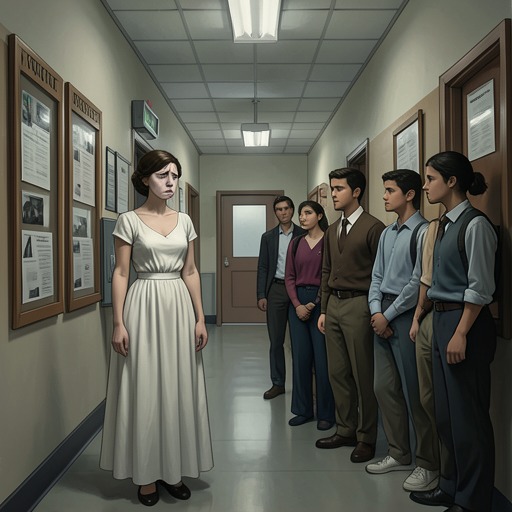
At the entrance corridor, an inscription in Latin prompts Mike to ask a passing student for a translation. Its biblical warning that people will become like gods, knowing good and evil, gives the institute an unexpectedly grand threshold. Mike links the words to the serpent in Genesis, while the setting’s actual work concerns measurements, data, and competing accounts of the universe. The contrast places lofty claims about knowledge beside the routine labor through which scientific knowledge is produced.
Research and academic life
Jennifer was an astrophysicist at Mount Lee, working in the Department of Terrestrial Magnetism at the Institute of Physical Problems. The department head, Bax Denziger, explains that its work is divided among laboratory and computer staff, postdoctoral researchers or assistant professors who direct that staff, and senior figures such as himself. Jennifer occupied the middle tier: she ordered and checked the flow of work, while also pursuing research of her own. Her role was therefore neither simply clerical nor wholly independent; it joined the processing of shared data to the development of questions she could investigate herself.
A large volume of data arrived each day and had to be checked, processed, and reduced. Jennifer’s own work included leads on the Milky Way’s Virgo-infall velocity, which she had been pursuing since the previous fall. The department’s broader concerns included the age of the universe, its rate of expansion and deceleration, and the total mass-density parameter. In shorthand, Denziger calls these Hubble’s constant, q-nought, and dark matter; the research also bears on whether the universe is open or closed. The scale of these problems sharply contrasts with the immediate, local questions of a death investigation, but Jennifer’s position within them makes her work central to Mike’s effort to understand the life behind the case.
The Institute is also presented through Mike’s awareness of generational change. She recalls that, when she attended the Academy, students seemed to perform conventional physical ideals of sexual allure; at CSU, she sees a student body less concerned with those displays. This is her perspective, not an institutional description, and it exposes the investigator’s own age and outsider status as she moves through the corridor. The university setting repeatedly measures the distance between what Mike knows and the world she is trying to enter.
The university and the investigation
CSU is also Trader Faulkner’s professional setting. When Mike considers bringing him downtown, she imagines sending officers to his department and having them remove him from a seminar or lecture hall. The plan would make a public spectacle of the arrest, even with lights but no siren; more importantly, it would exceed the evidence available. Although Colonel Tom believed the police had a basis to act, Mike recognizes that they do not yet have probable cause. She abandons the forcible plan and instead telephones Trader in his campus room at six in the morning, asking him to come downtown.
That decision makes CSU a place where investigative urgency meets legal restraint. The campus offers the police a visible route to their suspect, but Mike’s judgment prevents academic space from becoming the stage for an unsupported arrest. Her call converts the university from a potential site of coercion into the starting point for a requested interview, preserving the distinction between suspicion and the grounds required for police action.
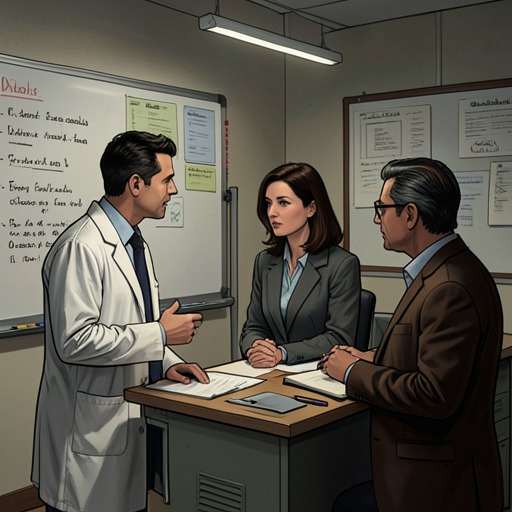
Mike’s visit to Bax Denziger’s office brings another part of the investigation into the Institute. The department head receives her coffee and agrees to speak on tape about Jennifer’s death, at the request of Colonel Tom and Miriam Rockwell. His office feels to Mike saturated with information, available at a touch, while Denziger himself is a practiced public communicator who explains his field in polished, camera-ready paragraphs. Their meeting gives Mike access to Jennifer’s daily work, but it also stages a mismatch: the detective has come to ask concrete questions about a dead colleague, while the scientist’s answers open onto the universe’s age, expansion, and mass.
Narrative significance
The CSU setting brings together three scales that the investigation cannot easily reconcile: the personal loss surrounding Jennifer, the procedural demands of police work, and the immense timescales of astrophysical inquiry. Jennifer’s data processing and independent research make her part of a hierarchy of collaborators, not an isolated scientific genius; Trader’s campus position makes him accessible to investigators, but not automatically arrestable. The Institute’s distant foothill location, its old observatory, and its questions about the universe enlarge the frame without resolving the case.
Mike’s movement through CSU is consequently a movement through the limits of her own knowledge. She can identify the institutional roles, ask for an explanation, and insist on proper procedure, but the scientific questions remain larger than her immediate investigation. The corridor inscription promises godlike knowledge, while the interview supplies only specialized answers and partial access to Jennifer’s working life. CSU matters because it makes that tension concrete: the search for what happened proceeds through people and evidence, even when the world those people study exceeds ordinary human scale.